Monday, July 10, 2006

What's Better: Round 1: Match 5 (Redick v Riddick)


As we pass the 1/2 way point of the first round, there are still some interesting challenges to go.

Today's battle is anyone's guess. In one corner we have a former Duke star (now with the Orlando Magic). In the other corner, we have a science-fiction extravaganza with Vin Diesel and Judi Dench (no, that's not a typo).

Sooooooooo...What's Better?:

J.J. Redick or The Chronicles of Riddick?

Sunday, July 09, 2006

What's Better: Round 1: Match 4


Today's matchup features two contenders you don't want to mess with, each with a lot more grit and determination than you might think at first glance. So, "What's Better?": Dixie Kong or the Dixie Chicks?

Saturday, July 08, 2006

What's Better: Round 1: Match 3


Well I think I know who'll win this one, but after yesterday's shocker, who can tell? So without futher ado, what's better:

"Puttin' on the Ritz" or "Taking it to the Streets"? (Remember, it's not just the song...it's the idea, the concept, the meaning of it all.)

P.S. Looks like we have a tie going for yesterday's vote, so we'll leave it with a golden goal situation--next vote (for either Natalie Portman) is the winner.

The Long Loneliness (210-235)

This section is given the title "Community."

I feel a resistance in myself when Day speaks of the poor. Resistance to what? I'm not sure. Often, if I parse her sentence, I find I agree with the meaning, for example when she writes:

"As Peter saw it, to live according to Gospel simplicity meant that you begged when you were in need and by this you gave the opportunity to the rich to become poor for Christ's sake. 'Appeals, not demands,' was another of his slogans."

The slogan resonates, and I have a hard time atriculating anything conceptually wrong with the passage (other than, perhaps, I'm suspicious of any understanding of "Gospel" anything that can be reduced to a slogan or focuses exclusively on our material goods). I do know that while reading it (and this section) I find myself mildly bored and vaguely irritated. Is this my conscience being pricked (and me not liking it)? Is it my sniffing a problem (but not putting my finger on it)?

Day speaks of advocating detachment from unecessary luxuries (cigarettes, beer, cosmetics, television, movies, radio) and using the savings to buy a farm. In this, she doesn't sound that much different from an investment columnist for Motley Fool who speaks of tracking your entertainment budget to increase savings. But she recognizes that there will always be illnesses, emergencies, things that may impoverish those who have not necessarily been profligate.

Maybe I just grate my teeth at the ease with which an "unecessary luxury" is defined. (Are there "necessary luxuries," I wonder?) I had a student once who was working on a speech that argued that Christians should not go to the movies, and one of her arguments was to point to all that could be done with the money Christians spent on movies if it were given to missions. Nice thought. Of course, she was on the basketball team, and I asked her how much money she had spent in her life on athletic shoes, equipment, tickets to games, seminars, etc. There really is a tyranny of the utilitarian argument.

Day's not naive, though. She recognizes many of the problems and possible contradictions in the actions she chronicles (her's and others'). One should embrace voluntary poverty...but a man is someone who should provide for his family. One should give profligately...but one should also save frugally.

Over all my reading, I suppose, is an enculturated attitude towards "the poor." I remember coming out of a theater many years ago after having seen Hoop Dreams and being behind two late middle-aged women and hearing one tsk-tsk that they couldn't pay their electric bill but "they all had televisions and $300 sneakers." I hoped I would never become so...(what was the word I thought, or did I even finish the thought?)...out of touch?...snobbish?...racist?....selfish? Since then I've learned that as one moves slowly up the food chain, calls for voluntary poverty can be received in a different spirit than when one has, relatively speak, generally less than one's neighbor.

Day does not romanticize the life of service or voluntary marginalization, and I appreciate that fact. She speaks of it as being hard and, at times, disappointing. Like others, though, she speaks of its rewarding aspects. Yet she often speaks of the hardships with more skill, detail, and pathos than she does of the rewards. I wonder if this is a function of a life of trying to get the blinded to see and feel the suffering around them and of less contemplation on the joys (whatever they may be).

Take, for instance, the passage where Day relates of a a farming commune in Northern Minnesota: "It was a grim experience, though all seem now to look back on their days there with nosalgia" (232). Here she speaks of her friend's philosophy of work: "But because of the Fall the curse is laid on us of having to earn our bread by the sweat of our brows, in labor. St. Paul said that since the Fall nature itself travaileth and groaneth. So man has to contend with fallen nature in the beasts and in the earth as well as in himself. But when he overcomes the obstacles, he attains again to the joy of creativity. Word is not then all pain and drudgery" (227).

In both of the passages cited above, the drudgery, the pain, the grimness of the experience seem so much more palpable and real than the abstract nostalgia and the joy of creativity. I'll be the first to admit that I have a gloomy disposition, so perhaps these phrases are just on a frequency I am more attuned to hearing. I was thinking, though, that I was reading Helen Prejean's Dead Man Walking in another context, and she does an excellent job of conveying the satisfactions or joys that can come with hard, painful, sacrificial giving as well as chronocling just how bad those less fortunate than her readers have it.

Or so it seems to me. There is, of course, always the possibility that I resist out of my own continued selfishness to distance myself from the poor and the call to love them.

What's Better: Round 1: Match 2


Is bald beautiful? Or are honeybuns sweeter than honey?

What's better? Natalie Portman in V for Vendetta or Natalie Portman in Revenge of the Sith?

Friday, July 07, 2006

What's Better: Round 1: Match 1


Okay, over at Arts&Faith.com, I was lamenting the apparent disappearence of one of my favorite time wasting web sites, whatsbetter.com.

The premise of the site was that you got two people, items, concepts, places, and you clicked on which one was better. Judging by the response to the A&F thread, it looks like I wasn't the only one who missed it.

So, to further promote numbingly mindless comparisons, I thought I'd try having a "What's Better?" tournament. I'll post 1 pair per day and see if I get any comments. Whichever pair gets the most votes (in the comment option) moves on. If there are enough responses, I might even make it double elimination. If there are no responses, I may just quit.

So here's your first "What's Better?" match up:

What's Better?
The March of the Penguins or The Flight of the Phoenix?

Monday, July 03, 2006

The Long Loneliness (182-210)

Okay. I like The Long Loneliness, really...

can you sense the "but" coming?

I've forgotten if the original list given by Renovare was called "Spiritual Classics" or "Devotional Classics" and I'm occasionally puzzled by the incorporation of some of the more autobiographical works into a category of devotional literature.

Hmmm...will have to look that up.

I have no notes on the chapter entitle "Paper, People, and Work." None.

Onto the section entitle "Labor."

Day says of Christ, "He spoke of the living wage, not equal pay for equal work in the parable of those who came at the first and the eleventh hour" (205). Interesting point. Intuitively I wanted to insert the phrase "minimum wage" for "equal pay for equal work." I wonder if this was a loose phrase or if there is a sense of this passage that I'm missing.

Ah, here's the passage, I had marked as the most troublesome for me:

"He died between two thieves because He would not be made an earthly King [....]His teaching transcended all the wisdom of the scribes and pharisees, and taught us the most effective means of living in this world while preparing for the next" (205).

One of the things I appreciate about Foster's Streams of Living Water, upon which parts of the Spiritual Formation Workbook seems to be grounded is the idea that in the different emphases of different traditions there is wisdom that can be gained. I have a deep respect for those brothers and sisters who have practiced in or advanced the Social Justice tradition, but I confess my knee-jerk, rigorously drilled I-V doctrinal, evangelical response to the first sentence was "Oh, is that why he died? I thought it was to wash away the sins of the world." I understand the two are not mutually exclusive, but I do remain concerned that in the writings that I would associate with the Social Justic tradition, Jesus can sometimes come across as a great teacher-thinker-exemplar (all of which he is) but a bit fuzzy on the whole Messiah-savior thing.

And yet...

So many who are advanced or practiced in the Social Justice tradition do (or appear to do) such a better job at following Jesus's teachings than I do that one feels a bit Pharisaical to question them on doctrine.

That being said, I'd feel on a bit firmer ground if there was a bit more about God/Jesus here and a bit less about the Catholic Daily Worker. But that's just back to the main point, which is that the subtitle is "Autobiography" of Dorothy Day, not the "Devotions of Dorothy Day."

Post Script--A search back to Renovare's page indicates that they do indeed label the list "Spiritual Classics" not "Devotional Classics"

Saturday, July 01, 2006

World Cup 86


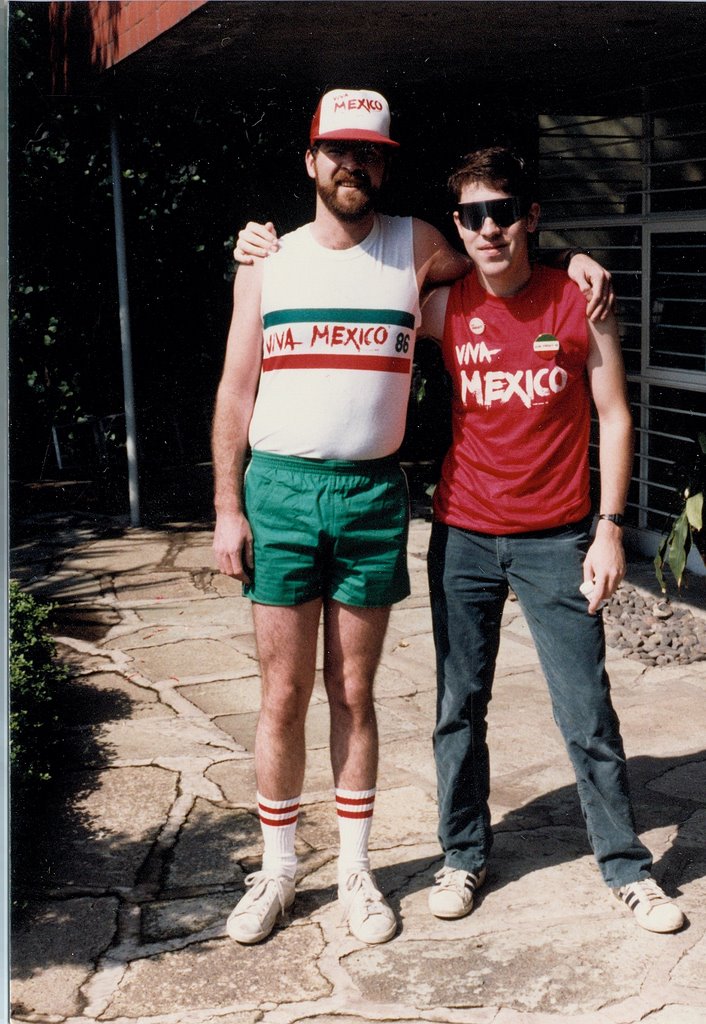
My brother and me on the way to the Mexico-Bulgaria knockout game in 1986. No way we were getting mistaken for Bulgarians at the Estadio Azteca. (I'm the one in red.)

Friday, June 30, 2006

Scott Kingsolver reviews Superman Returns

I'm pleased to provide some review space over at Viewpoint for Scott Kingsolver's review of Superman Returns. Scott is a Broadcast and Electronic Media major at the University of Oklahoma, and he is minoring in Religious Studies.

MoviesMatter.com to Host Some Content

The fine folks at MoviesMatter.com have offered to house and archive some of my reviews that didn't run at Christian Spotlight.

The review for Ushpizin was the first that was moved over there. The layout of the site looks great, and there is lots of good content over there. Check it out.

Tuesday, June 27, 2006

North Carolina State Games

Nice disc golf weekend. Shot a pair of 49s at Kentwood during the North Carolina State Games. I don't think I've ever shot a PDGA round under par before. Yeah, it was Kentwood, but still...I was happy.

Then on Monday I won random-draw doubles for the first time ever. Shot a -12 with my partner at OT Sloan in Sanford.

Okay, Wes (my partner) shot like a -10 and I got one or two holes with good drives to help the score. But, hey, our pay out was the same...and while he probably woulda still birdied (no, that's not a misprint) hole 11 (I was no help), I did have a few drives we ended up using, so who knows what our scores would be with other partners. That's doubles.

Saturday, June 17, 2006

Forgiving Dr. Mengele

Uploaded a review of Forgiving Dr. Mengele at Viewpoint.

This documentary chronicles the story of Eva Moses Kor, an Auschwitz survivor who sparked controversy when she decided to announce that she had forgiven the Nazis.

Thursday, June 15, 2006

The Long Loneliness (167-181)

The title of this section is "Peasant of the Pavements."

I thought once or twice while reading this section about long gaps in some scriptural passages, particularly the histories. Moses flees after slaying the Egyptian and then...fast forward to an older and wiser man confronted with the burning bush.

How often people have wondered about those gaps, longed, perhaps, for some arcane bit of lost knowledge that might help explain the transition.

Yet more information rarely does the trick.

This section of Day's work often felt slow to me, and I had trouble sharing her enthusiasm for the particular details that stayed in her memory. Perhaps this is partially why I have difficulty with devotional literature. There is still a straining, from youth, after the significant, that makes one want to gloss over the daily, the mundane, and in doing so to chafe against those who do not. Even in the scripture, there are passages that are intensely descriptive of a moment--the Psalms come to mind--that I've always had trouble reading. Perhaps as I get older, I will come to appreciate those forms of expression that linger over the moment more.

Day and her friend talk of a calling to make a society in which it is easier for men to be good. I chafed, too, against this message. Is it ever easier to be good? I think there is a misunderstanding of human nature there--but an argument could be made, I guess. Certainly the New Testament teaching on the rich and poor--saying it is easier for a camel to go through the eye of a needle than a rich man to inherit the kingdom--might be read to mean there are all sorts of varied difficulties than different segments of society have. Emotionally I certainly FEEL like it is harder to be good when I have less power or control or money, but experentially, I haven't known that to be the case.

So maybe I'm struggling to understand Day's conception of the social justice strain of the gospel and to reconcile it with my own experience and beliefs. I recently finished Helen Prejean's Dead Man Walking, and there was a strain of social justice there--voluntary poverty (material and spiritual)--that while no easier to practice, made sense to me and was (key point) recognizable. Perhaps I'm a Gen-X cynic who thinks the prospect of changing society on an institutional level is just impossible and hence those who advocate it are naive...but, then, changing one human heart is impossible too, so perhaps the same God who can inspire one soul to pray for another against nearly impossible odds can equally insipre one soul to work against a sea of impossible odds to effect large changes in institutions, not in the belief that they will be permanent, but in the hopes that they will be good.

Sunday, June 11, 2006

Disc Golf in All 50 States--The Quest Continues

One of my life goals is to play Disc Golf in all 50 states.

This year, my quest moved forward, and I reached the 30 state plateau. I also have now played 75 different courses.

That's the good news.

The less good news is that my play, like my application of other skills, has it's ups and downs. I thought I was playing better. Indeed, I played several difficult courses under par this year. Then I returned home and promptly threw a 61 at Buckhorn, a full 5 to 6 strokes over my average. Golf is a game of rhythm and comfort and practice.

Here are some scores from this year.

Brahan Springs Park; Hunstville, Alabama

3-3-4 2-3-3 4-2-2 OUT (26)
3-3-3 3-2-2 3-2-3 IN (24) 50

LaFleur's Bluff State Park: Jackson, Mississippi
(Doubles w/ Cindy)

4-3-2 3-4-2 3-3-3 OUT (27)
3-4-3 3-3-3 2-3-2 IN (26) 53

Lazarre DGC; West Monroe, Lousiana
(Doubles w/Cindy; High Water Course; Short Tees)

2-3-2 3-3-3 3-2-2 OUT (23)
3-3-3 3-3-3 2-3-3 IN (26) 49

Muse Park: Jackson, TN

2-2-3 3-3-2 2-4-4 OUT (25)
3-3-3 3-3-3 3-3-2 IN (26) 51

It hasn't been all birdies and light, though. Seven oaks in Nashville chewed me up and spit me out.

Friday, May 26, 2006

Citizen X (1995)

Uploaded a new review of Citizen X at Viewpoint.

Thursday, May 25, 2006

The Long Loneliness (139-166)

This section encorporates the end of "Love Overflows" and "Jobs and Journeys." The latter is the last section of Part II: Natural Happiness.

There is a distant, sketchy quality to some of these passages that I found familiar. In those rare times that I have looked back on my own journals I have noticed long silences during significant changes in my life, silences that seem to testify to the fact that life was occuring.

I also found it interesting that Day reports an increase in her feelings of isolation upon joining the church rather than a decrease. There's a lot of truth to that, I thought. Before joining the church, her relationships were found on common interests, goals, desires. Fellowship was easier. The association in an institution often feels like a familial one--the bonds being external, feeling arbitrary.

Do not those in the church have common interests, goals, desires? Should they not? Why does it always feel as though the closeness to other Christians is a mandated chore rather than an affinity? Certainly in Day's case, it is easy to see that the institution stood (if only symbolically) against ideas and people whom she held dear. One hopes that the reality of the people one meets in the church dissolves one's false image of the church and makes it easier to challenge one's own stereotypes. Day says, though, that she often attended mass, gave confession, etc. but "after three years" she still "did not know personally one Catholic layman" (166).

I suppose of especial interest is the fact that Day uses the phrase that makes her title in this section. She claims that women are "especially" social beings, "who are not content with just husband and family, but must have a community, a group, an exchange with others" (157-8). "Young and old, even in the busiest years of our lives, we women especially are victims of the long loneliness" (158).

I'm not sure I buy this, any more than I buy generalizations about gender made by John Grey in Men are From Mars, Women are From Venus...Do I think men and women are essentially different in some ways? Yes, I suppose so. But whenever someone tries to articulate those differences, the descriptions strike me as too pat, too generalized. I know some women who claim to be and appear to be deeply introverted, who don't seem to be "especially" social nor particularly dependant upon an exchange with others. I know some men who need a community, who can do just about anything except be in alone with themselves for five minutes.

But that is too nitpicky, I think. Why must I pick the sentence out of a 100 that makes me say, "I disagree" rather than listen to those parts which resonate and connect and learn what I can from them?

Sunday, May 14, 2006

The Long Loneliness (109-138)

Yes, I am still reading the Long Loneliness. What with buying a house, getting in final grades, graduation, etc., I'm behind. What else is new?

I'm also slogging through this section because a lot of it is about the joy of giving birth, how every woman's deepest desire is to be a mother, etc.

But I don't mean to be glib.

Clearly having a child was an important paradigm shift in Day's life, and reading about it did make me think about how living for someone other than yourself can be clarifying for those facing existential, theological, or religious quandries.

Day writes:

"I had been passing through some years of fret and strife, beauty and ugliness--even some weeks of sadness and despair. There had been periods of intense joy but seldom had there been the quiet beauty and happiness I had now" (135).

Nothing profound, but one of the interesting aspects of Day's writing is the way in which she differentiates similar emotional states. It leads to my thinking about what the difference might be between happiness and joy, sadness and despair, etc.

Thursday, May 11, 2006

April Viewing Log

*= a second (or later) viewing
4/7--Elizabethtown (DVD)
4/7--Domino (DVD)
4/12--La Promesse (DVD)
4/18--We Don't Live Here Any More (DVD)
4/18--Million Dollar Baby* (DVD)
4/27--Aeon Flux (DVD)
4/27--Capote* (DVD)
Hmmm. April was not exactly the cruellest month, but in terms of movie watching, well I was grading a lot of papers and moving, so not much of interest on the slate. La Promesse (Dardennes) was probably the best. I thought Aeon Flux and Domino were stupid, but give a special prize to Elizabethtown for being irritatingly bad.

Saturday, April 29, 2006

Stephens County Pro Am 2006

Driving in to Toccoa is a bit like going to the dentist.

You may like the dentist you have now, and your memories of past incidents may not be uniformly horrific, but there usually isn't much on the plus side of the memorial ledger to engender nostalgia feelings.

Driving in to Rose Lane, then, is a bit like meeting up with a friend who stood by you during a court martial or a unit you fought a war with. On the one hand, you have strong feelings of loyalty. On the other, those feelings are inextricably embedded in negative memories.

The course is windy. Very, very, very, windy. The kind of windy that when I was living in Toccoa I would have turned around and driven home. But I've driven six hours, so I guess I'm staying.

Despite the wind, I birdie three of the first six holes (and make a long putt to save par on another). And then...

...then the same old tournament same old. I hit trees a few feet in front of my tee pad. The wind carries me places I never shoot from. Despite putting well all day, I manage to turn a 3 down into a 4 over, and when I come back for the afternoon session, I have to play the long tees. I'm tired. I've driven six hours. My ankles hurt on a course that's a tough walk, and the holes get longer.

My agressive putting results in my first three putt on the opening hole of round two, but despite that and an out of bounds, I jump on the three train for some long holes and manage to put together a stretch of play. Then the wind blows up again and I go out of bound on hole 5 and take a circle 6. Pffft.

You know, I should be happy. Lot of good things are happening in my life. I just bought a house, my work year is drawing to a close. But I've been in a terrible mood all day. Maybe I just shouldn't play tournaments, I don't konw.

Last Monday, I was playing blind-draw doubles at OT Sloan with a payout of the top 3 teams. My partner and I shot a -10. Three of the last five groups to come in tied at -11. It's been that kind of Disc Golf year.

And the thing is, I putted well. I could have been an additional ten strokes easy. I try to tell myself that it was the wind, the layoff, the new hole configurations, but the truth is I'm Michael Chang slugging it out with Andre Agassi and Pete Sampras. Moving up to Masters level just means maybe that it's Jim Courier or Boris Becker. Maybe they don't hit as hard as Sampras, but they still hit harder than me. And I can make all the twenty-five foot putts I want, that still itsn't going to gain me strokes if they are to save par on 325 foot holes.

I try to tell myself that I've just got residual bad mood from a conglomeration of negativity that has been surrounding me recently. People saying they aren't in a bad mood who obviously are. Cruddy drivers on the road. Passive-agressive sulkers in many spheres of life.

Anyway, it's nice to see the course, even if the holes I remember nostalgiacally are being systematically moved, lengthened and replaced.

Round 1 (5664 feet) (Starting on hole 12)

3-3-3 2-2-2 4-5-3 3-3 (33)
3-3-4 2-4-4 4-4-3 3 (34) 67

Round 2 (6580 tired feet) (Starting on hole 11)
4-5-3 4*-3-3 3-3-4 3-3* (38)
3-3-3 3-6*-3 3-4-3 4 (35) 73

Sunday, April 23, 2006

Dumbest Thing I've Heard at the Euchre Tables This Year

So I was playing a game at Hardwood (I know, Yahoo! has been slow recently).

My partner ditched the game, and after a brief wait, I went ahead with the robot partner...

To which one of the players objected that the game was unfair...

...because the robot partners never make mistakes.